
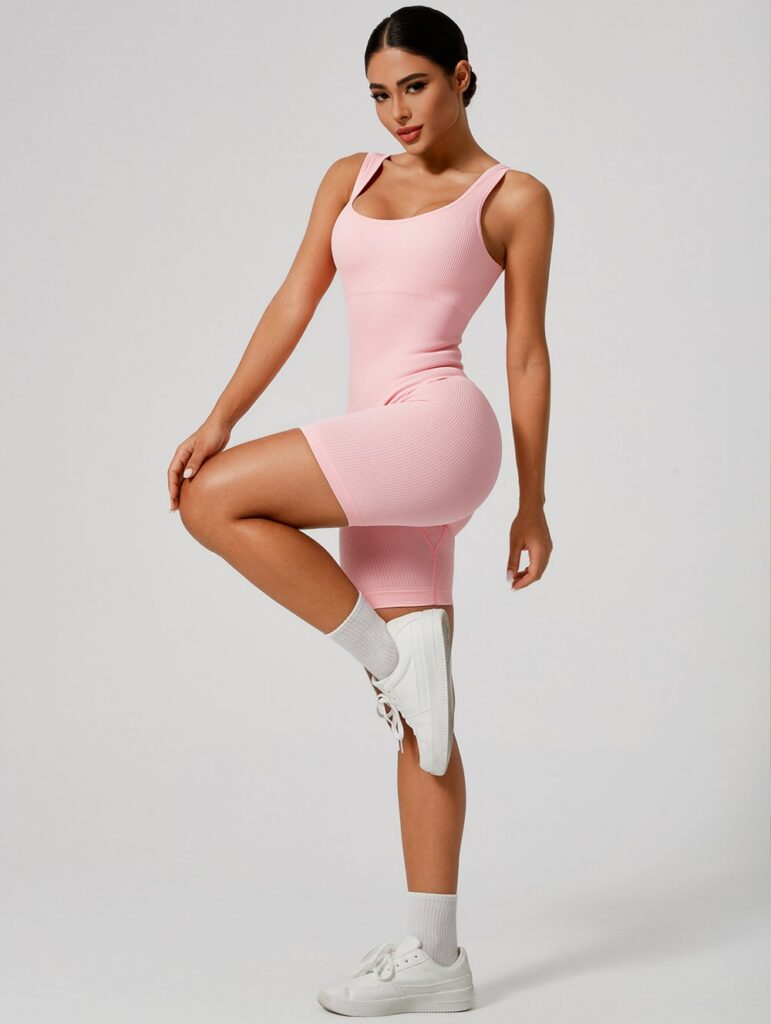
For a bodysuit enquiry, ask which two supplier-named edges define any stated strap width and where along the strap the declaration applies. Link the answer to the actual offered style and reference revision. A catalogue description of wide straps or a front photograph does not establish endpoints, a dimensional value, fit, comfort, or support.
The buyer’s immediate task is to understand the supplier’s dimensional statement before entering it in a specification record. A width value can appear clear while leaving its location or physical boundaries unspecified. Keep those limitations visible rather than choosing a convenient point in the photograph or treating a familiar product name as a complete measuring convention.
Identify the exact short-length bodysuit offer
Use the short-length ribbed bodysuit catalogue reference to anchor the enquiry. The catalogue names the product and describes its neckline and straps, but those descriptions are identity references rather than independently established dimensions. Add the supplier’s actual offer, variant, and revision when provided. Keep a response for another bodysuit separately identified until the supplier states its applicability.
If the supplier provides only a size label, retain it as the stated label without converting it into a dimensional result or current-stock claim. Ask which offered version the strap statement covers. A shared catalogue page or familiar size series does not establish identical strap references across every version or complete an unanswered endpoint field.
Separate strap width from other garment records
A torso measurement statement concerns another span when the supplier actually defines it. A physical size-code mapping identifies an offered label or order-line relationship. Care-text wording concerns a different record entirely. None supplies the boundaries of a strap-width declaration by inference, even when the same bodysuit identity appears in the correspondence.
Keep these references attached to their own subjects rather than combining them into a complete garment specification. A confirmed torso datum should not make a missing strap datum appear answered. Similarly, a supplier’s care wording does not establish material behaviour, a strap dimension, or a fit result. The new enquiry should remain focused on the stated width and its physical reference.
Establish whether a width is actually declared
Ask whether the supplier provides a strap-width statement for the exact offered style. If no value is supplied, record not stated or not provided according to the response. Missing is not zero. Do not derive a figure from catalogue proportions, a different garment, or a descriptive term such as wide.
If a value is supplied without a clear subject, preserve it as an incomplete supplier statement and ask which strap or region it concerns. Retain the original metric wording rather than relabelling a nearby dimension to fit the buyer’s worksheet. A partial answer remains useful when the unresolved component relationship is visible beside it.
Request both edges and the stated strap location
For a declared width, ask the supplier to identify the first and second physical edges delimiting its span. Request an attributable marked reference if one is supplied. Keep the names and boundaries as actually stated rather than choosing an apparent seam, trim, or image outline on the supplier’s behalf.
Ask where along the strap the declaration applies. A value attributed to one supplier-named position should not be expanded to every part of the strap or another component. If the supplier does not identify a position, retain that gap. The buyer should not assume uniform width or supply a location merely to make the record look complete.
Record any garment state, unit, and reference revision actually provided with the statement. If they are missing, ask for clarification rather than assuming a stretch state or converting an unexplained quantity. This enquiry documents the supplier’s datum; it does not prescribe how a person should measure a garment, photograph, or body.
Use a strap-width enquiry record
Record field | Supplier evidence requested | Boundary to retain
Offer identity | Exact bodysuit style and revision | No transfer between garments
Width status | Literal strap-width wording if supplied | No value inferred from wide
First edge | Supplier-named physical boundary | No buyer-selected seam or trim
Second edge | Supplier-named physical boundary | Unstated endpoint remains open
Strap position | Declared location and reference revision | No assumed uniform coverage
Disposition | Datum recorded or clarification pending | No fit, comfort, or support approval
The table is a purchasing record, not a proposed size specification. Its fields do not establish a value or a particular edge construction. Empty fields mean evidence has not been supplied or linked. Preserve those meanings when the record is copied into another comparison sheet, rather than letting a populated number field hide the missing boundaries and position.
Resolve a practical quotation ambiguity
For example, a buyer may receive a bodysuit quotation and a separate diagram containing a strap-related dimension without a marked location. Ask which offered version, physical edges, and strap position the supplier intends. Until clarified, retain the diagram as an incomplete reference instead of assigning the quantity to the entire strap.
Another response might name a location but provide no applicable revision or unit. Keep that answered portion and request the remaining basis. The buyer can preserve useful partial information without completing it from another bodysuit’s specification or from an image interpretation. A focused follow-up should identify the exact relationship that remains unanswered.
Maintain the version scope and limits
When an offer changes its style or component reference, ask whether the earlier width declaration remains applicable. Retain the original answer with its original version. An unchanged catalogue image does not establish unchanged dimensions, while a revised reference does not independently confirm a production, packing, dispatch, or delivery event.
The enquiry can close with an attributable strap-width basis, an incomplete boundary statement, or no supplied metric. It does not establish compatibility, wearer fit, support, comfort, material properties, manufacturing capability, or a care procedure. Other garment and commercial questions retain their own supplier evidence and open fields.
Frequently asked questions
Does a wide-strap description establish a numerical width?
No. Use the catalogue wording as an identity reference. Request the supplier’s actual width statement and its two physical boundaries rather than turning a descriptive label into a value.
Does torso sizing define the strap-width endpoints?
No. These are different dimensional subjects. Keep the torso record separate and request the supplier’s actual strap edges and applicable position if a width is declared.
What if the supplier does not state where along the strap the value applies?
Record an incomplete datum and request the location. Do not assume uniform width or choose a point from the catalogue photograph to complete the statement.
Does confirming the datum establish comfort or support?
No. This record clarifies supplier correspondence. It provides no measuring, wearing, manufacturing, care, or testing procedure and no fit, comfort, support, or performance assessment.
Request the exact strap reference
Send the bodysuit offer identity with the width-status, edge, position, unit, and revision questions. Keep unresolved scope beside the supplier’s answer so later correspondence can close the precise dimensional gap.
https://zrknitwear.com/product/seamless-ribbed-workout-bodysuit-short-length/
https://zrknitwear.com/contact/
https://zrknitwear.com/blog/