
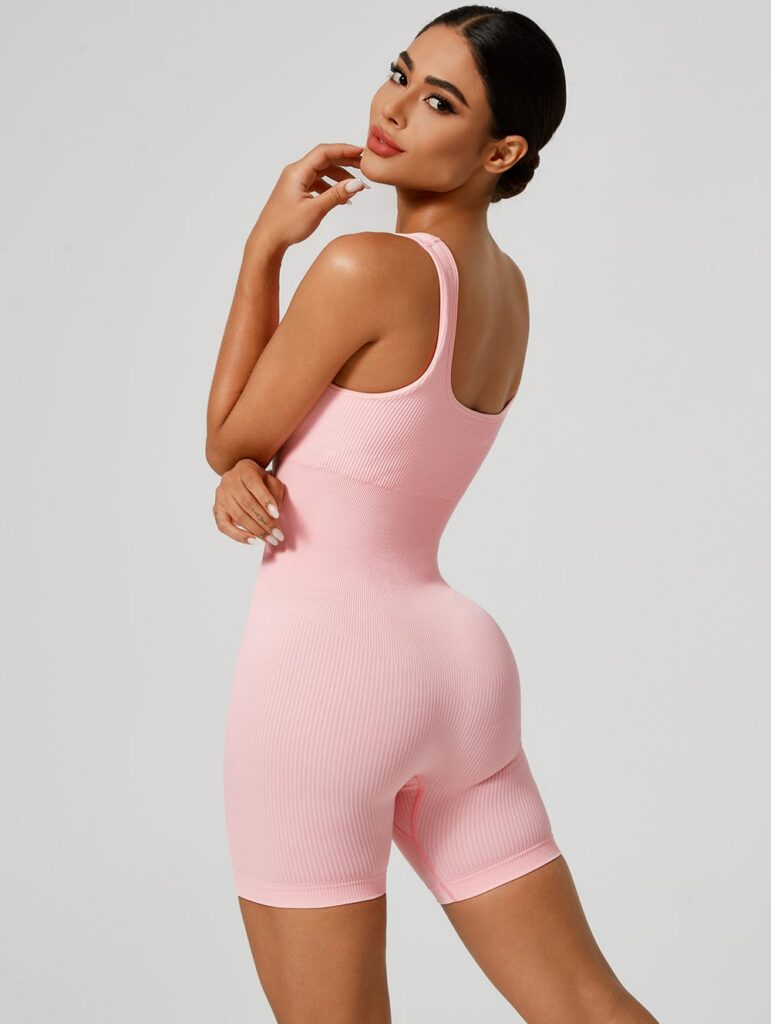
A front photograph of a short bodysuit does not establish the finish supplied at its leg openings. For the historically named Seamless Ribbed Workout Bodysuit offer, request the supplier’s own declaration and the garment region it covers. A useful buying record separates an attributed finish description from assumptions about trim, construction or performance.
Identify the supplied bodysuit version
Use the exact short-length bodysuit identity and ask which supplier version the response concerns. Retain any offer or garment-reference revision supplied with the answer. The catalogue name is a filing reference; the word Seamless does not establish the construction of a particular edge or verify a manufacturing method.
Keep the buyer’s requested configuration separate from the supplier-confirmed offer. If a reply refers to another garment version, retain that context and ask whether its edge description applies here. A similar product name or front view does not establish that an earlier declaration covers the current enquiry.
Ask whether a finish is declared
Request an express supplier description of the supplied leg-opening edge finish. If no description is provided, record finish not declared. This status preserves the evidence gap without claiming that the garment has no finish, that a particular treatment is absent or that any assumed alternative is supplied.
Where the supplier points to another reference, retain its identity and ask which region the statement addresses. A general note about the garment may not identify its leg openings. Keep the note within its actual scope while requesting the missing component-specific declaration, rather than broadening it to every garment edge.
Keep the region distinct from adjacent questions
The current enquiry concerns the supplier’s named leg-opening edge. It does not resolve a crotch opening or closure, a neckline boundary, a strap connection or the garment’s torso dimensions. Keep those product questions in separate records so a reply about one region is not reused as evidence about another.
For example, a supplier response might discuss a crotch configuration while leaving the leg-edge finish unnamed. Preserve that response under its actual subject and identify the unanswered finish question. The buyer should not transfer a closure description to the leg opening simply because both appear in the same garment correspondence.
Retain literal finish and component terminology
Copy the supplier’s own finish term with its attribution. If the wording mentions a component, ask which named component and supplied region it covers. Keep trim not confirmed where the answer does not establish trim inclusion. An unfamiliar term should remain attributable wording until the supplier clarifies its applicable scope.
Do not replace an unclear response with a binding, elastic, stitch or edge-construction label chosen by the buyer. None is established by the photograph. A named supplied finish also does not prove a process, fibre composition, stretch characteristic or result such as comfort, grip or durability for the bodysuit.
Link the declaration to a reference
If the supplier provides a marked product reference, request its version and the region associated with the stated term. Retain that identifier beside the declaration. This is a request for existing supplier evidence, not an instruction to produce a design service or physically examine, open, alter or test the garment.
A statement can be attributable while its coverage remains incomplete. Preserve the identified version and mark the relevant region unresolved when necessary. This gives the next enquiry a precise target without discarding useful evidence or turning a partial response into a declaration about every leg-opening feature.
Use a region-specific declaration record
Field | Supplier record requested | Boundary retained
Bodysuit identity | Exact supplied version and offer reference | Requested version stays separate
Declaration status | Finish supplied or not declared | No description does not prove absence
Literal terminology | Supplier edge or component wording | Buyer interpretation is not substituted
Covered region | Named leg-opening applicability | Crotch and other edges stay distinct
Open scope | Trim or reference not confirmed | Unnamed construction remains unresolved
Add the supplier respondent and response revision to the record. Another buyer can then identify where the description came from and what it actually covers. The record does not assess fit, support, stretch, care or performance, and it supplies no construction detail to fill an unanswered field.
Resolve inconsistent responses without inference
If different replies use different finish terms, retain each with its own version and respondent. Ask whether they concern the same supplied leg-opening region and whether either replaces an earlier statement. Different wording alone does not establish a physical garment change or show that a term applies more broadly.
A focused follow-up can name the unresolved term, region or revision. Keep that question separate from requests about size labels or general garment quality. The supplier can then address the specific evidence gap without the buyer presenting an assumed edge treatment or an unsupported expectation about manufacturing or offered services.
Keep the purchasing conclusion narrow
The resulting record may show a supplier-attributed term linked to a named region of an identified offer. It may instead show that a declaration is missing or that applicability remains unresolved. Neither state should be converted into a broader judgement about garment suitability, wearer coverage or the supplier’s production capability.
If a later offer changes the version reference, request whether the earlier declaration remains applicable. Preserve the original record and the new response separately. This provides a traceable account of the supplier’s statements without promising construction consistency, current availability or a particular result from a later order of the bodysuit.
Frequently asked questions
Does the Seamless product name establish the leg-edge finish?
No. It identifies the historical bodysuit offer for the supplier enquiry. A specific finish requires an attributable declaration covering the named region. The catalogue wording does not verify edge construction, fibre composition, manufacturing method, stretch or performance, and a front photograph does not supply those facts.
Can a crotch-closure description answer the leg-opening question?
Keep it within its stated subject unless the supplier expressly identifies its applicability to the leg-opening edge. A closure record should not become a finish declaration by association. Ask for the missing region-specific statement while retaining the existing response under the question it actually addresses.
What should be recorded when trim is not identified?
Retain trim not confirmed and preserve the supplier’s literal wording and reference. Do not infer a supplied component or its absence from an unclear reply. A later clarification can identify the component scope without changing the evidence of what the earlier response actually stated.
Does a finish declaration establish comfort or durability?
No such result follows from this record. It concerns the supplier’s named supplied form and applicable region. Fit, comfort, strength and other performance subjects require their own evidence and should not be inferred from a finish term, catalogue label or garment-identification photograph.
Product reference
Use the historical short-length bodysuit identity when requesting the supplier’s region-specific edge declaration.
https://zrknitwear.com/product/seamless-ribbed-workout-bodysuit-short-length/
Provide the offered version and existing supplier wording, and identify whether the unresolved question concerns the finish term, a named component or its applicable garment region.
https://zrknitwear.com/contact/
Further garment-related procurement records are available through the article index.
https://zrknitwear.com/blog/