
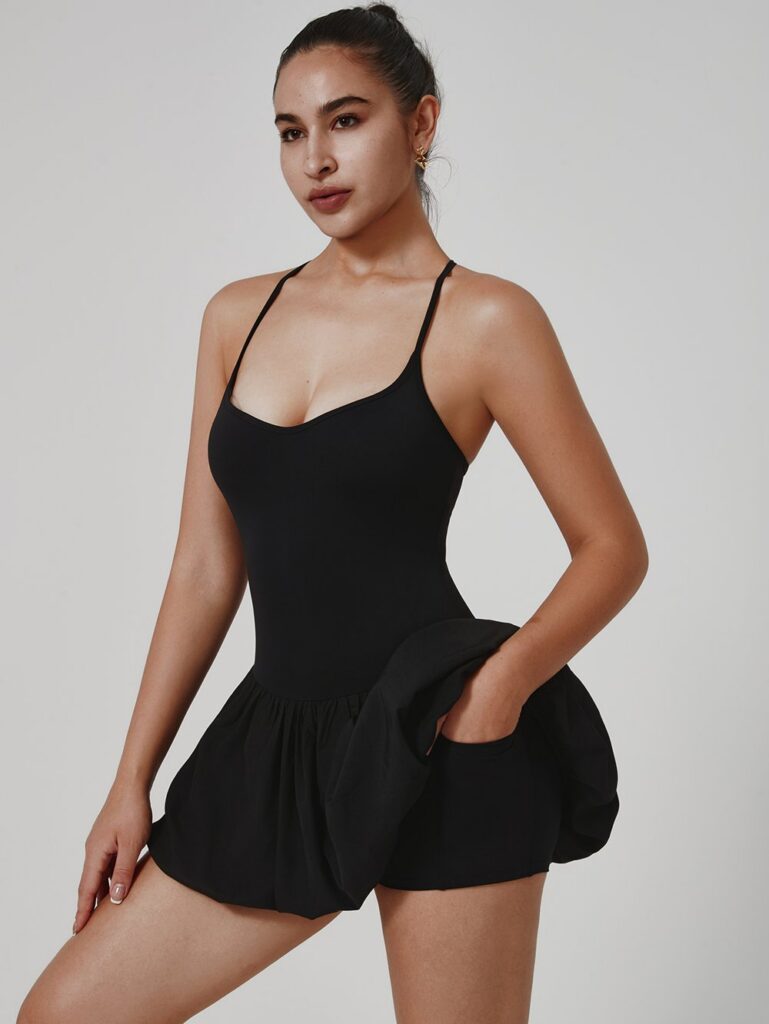
An inseam statement for inner shorts needs an identified garment component and supplier-defined reference points. For the historically named tennis-dress offer, first confirm the actual inner-short configuration supplied with the quoted version. Only if the supplier declares an inseam length should the buyer request its landmarks, garment state, unit and attributable reference. The front catalogue image does not establish hidden endpoints.
Confirm the quoted dress configuration
Use the exact Ballet-Inspired Cross-Back Tennis Dress with Built-In Shorts identity to anchor the enquiry. Ask the supplier which dress and inner-short version the response covers. The historical product name does not replace confirmation of the configuration actually included in the current offer or establish the form of its hidden components.
Keep inner-short inclusion not confirmed separate from a missing length declaration. These are different evidence gaps. An answer about the offered configuration can be useful while leaving its dimensional statements unresolved, and a reference to an inseam should not silently establish component inclusion when the supplier has not identified it.
Establish whether a length is declared
Once the applicable inner-short configuration is confirmed, ask whether the supplier explicitly declares its inseam length. If no statement is supplied, retain length not declared. Do not convert that status into a value of zero, an absent seam or a conclusion about the length or coverage of the garment.
An older size document may name another dress or inner-short version. Preserve its original scope and request applicability before using it here. A shared catalogue family does not establish that its component references or dimensional basis also apply to the exact configuration identified in the buyer’s current enquiry.
Request the supplier-named landmarks
Only an actual length declaration creates a span whose reference points can be clarified. Ask the supplier to name the start and end landmarks in its own reference. This article supplies no standard endpoint, physical measurement method or dimension; the requested basis must come from the attributable supplier statement.
Where a reply mentions an inseam without identifying its landmarks, retain datum unresolved. Do not choose a familiar garment reference to fill that gap. The purpose is to understand the supplier’s stated span, not to create a new span that could appear comparable while referring to a different part of the inner short.
Identify the covered leg or component
Request which inner-short leg or component the declaration covers and retain the supplier’s exact description. Do not extend one named reference to every component or garment size through assumption. If the response supplies a marked document, connect the named component and landmarks to that document’s actual identifier and revision.
For example, a supplier may provide a length statement whose component reference remains unclear. Preserve the statement and ask whether it concerns the confirmed inner short or another garment region. This clarification is separate from inspecting hidden construction and requires no instruction to lift layers, open the dress or handle the garment.
Keep state and unit attributable
Ask the supplier to identify the garment state and unit associated with its own declaration. Preserve those fields literally, including any unresolved wording. A missing state or unit should not be supplied by the buyer simply because another document commonly uses one; the current statement needs its own attributable basis.
Literal size labels also remain separate from the datum. Catalogue labels such as S, M, L and XL do not supply a conversion, measured chart or current availability. If a statement names a supplied size reference, retain that identity without inferring wearer fit, grading correctness or dimensions for other size labels.
Build the conditional datum record
Field | Supplier evidence requested | Unresolved status retained
Offered configuration | Exact dress and included inner-short version | Inclusion not confirmed
Length statement | Attributable inseam declaration | Length not declared
Landmarks | Supplier-named start and end references | Datum unresolved
Covered component | Named inner-short leg or region | Component applicability unclear
State and unit | Literal declaration basis and revision | Unprovided fields remain open
Record the supplier respondent alongside the document identity. Another buyer should be able to distinguish a confirmed component reference from an unclarified dimensional statement. The record does not calculate a length, convert units, assess fit or provide a garment measurement procedure in place of an absent supplier explanation.
Separate inner-short and outer-dress subjects
The current span concerns the confirmed inner short, not the outer-skirt length, bodice lining or rear strap connections. Keep those subjects distinct even when they share a catalogue page. A clear statement about the outer dress does not identify the landmarks used for a hidden inner-leg length.
Likewise, an inner-short declaration does not establish modesty, comfort, stretch, support or wearer coverage. Those conclusions are outside this record. Its useful result is an attributable description of what an existing supplier length statement refers to, with any remaining configuration or reference gaps visible rather than replaced by assumptions.
Manage revised references carefully
If the supplier changes a configuration or document revision, ask which prior datum statement remains applicable. Preserve both versions and the response linking them. A new file name alone does not establish that the span has changed, and an unchanged product name does not show that its reference basis remains identical.
The next purchasing question can then address a missing inclusion confirmation, an undeclared length, an unnamed landmark or an unclear unit. Those gaps require different supplier answers. A precise record avoids asking for a broad garment approval when the actual unresolved issue is the meaning of a particular attributed inseam statement.
Frequently asked questions
Does the front product photograph identify inner-short landmarks?
No. It is a product-identification reference and does not establish hidden component endpoints or a length. Request confirmation of the supplied inner-short configuration first, then clarify a datum only if the supplier explicitly declares an inseam statement for that identified component and version.
Can the outer-skirt length supply the inner-short datum?
No relationship should be inferred. Keep the outer-skirt statement within its actual scope and request the supplier’s separate inner-short reference if needed. Sharing a dress identity does not make the two garment regions or their declared dimensional bases interchangeable for this procurement record.
What if a length is provided without a unit or garment state?
Preserve the attributed statement and mark the missing fields unresolved. Ask the supplier which unit and state its declaration uses. Do not convert, complete or reinterpret the statement through an assumed convention, and do not supply a physical measurement procedure as a substitute for clarification.
Does a complete datum record prove fit or wearer coverage?
No. The record identifies the scope of an existing supplier statement. Fit, grading, modesty, support and performance are separate subjects requiring their own evidence. A named span and its reference points do not establish how the garment will perform or cover any particular wearer.
Product reference
Use the historical tennis-dress identity when asking which actual inner-short configuration and supplier statement the enquiry concerns.
https://zrknitwear.com/product/ballet-inspired-cross-back-tennis-dress-with-built-in-shorts/
Send the offered version and existing dimensional reference, then identify the unresolved component, landmark, state or unit for the supplier’s response.
https://zrknitwear.com/contact/
Further garment-related procurement records can be found in the article index.
https://zrknitwear.com/blog/