
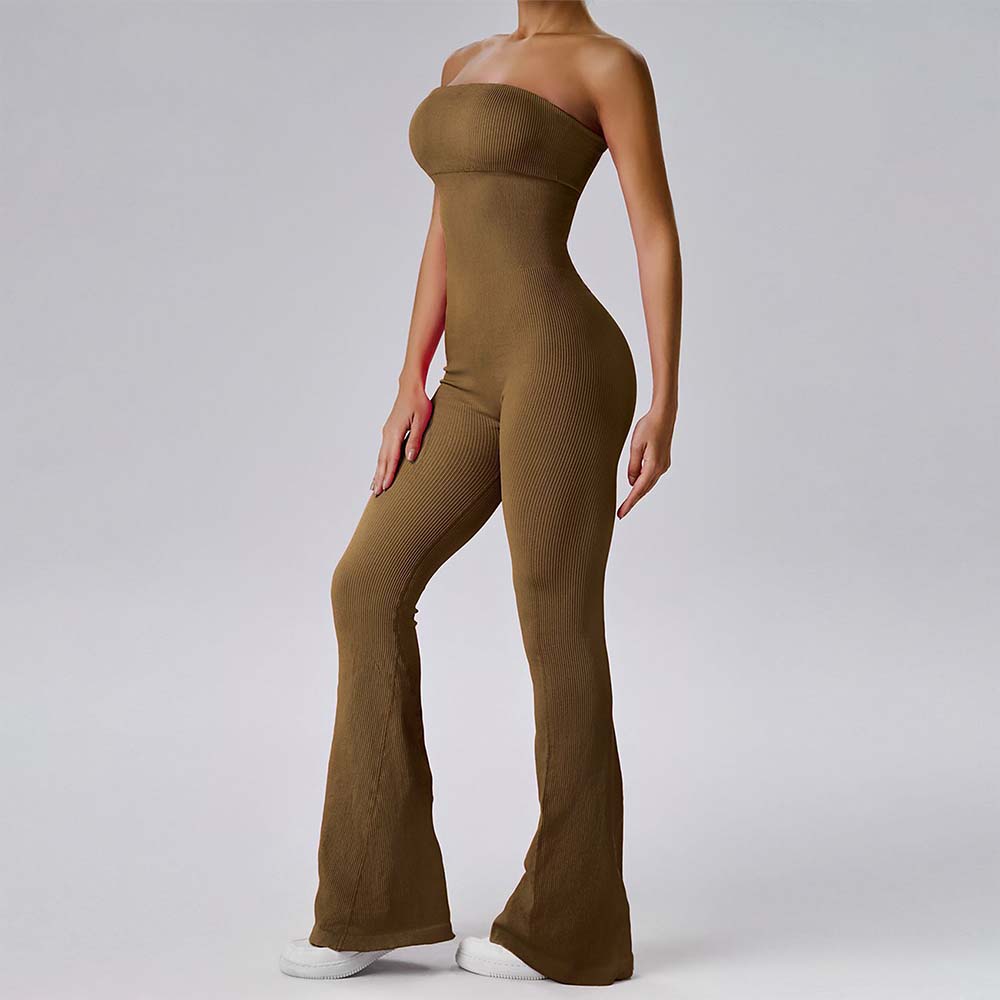
Separate a flare-jumpsuit material claim by asking which exact garment component each supplier declaration covers and what reference supports it. Record the supplier’s literal wording, the article identity and unresolved scope separately. Do not turn a catalogue adjective or a fibre percentage associated with another style into a verified composition for this offer. The buyer’s output is a component-level declaration record, with unknowns visible rather than filled by assumption.
Identify the reference garment before the material question
ZR Knitwear’s selected catalogue page names a Seamless Bandeau Flare Jumpsuit and describes a strapless bandeau form with wide or flared legs. These are product-identification references. They do not independently verify the fibre content, any additional component or a performance result. The selected official image helps identify the offered style, but it cannot establish the composition of the visible body or an unseen part of the garment.
Begin the request with the exact product-page reference and the supplier’s offer identifier. If a sample is being discussed, ask which sample the response covers. A general statement about a product family is a different scope from a declaration for a named offered article. Preserve that distinction. The supplier may need to clarify its scope before the buyer can compare the response with its purchasing requirements.
Ask what the statement actually includes
A short material description can leave several questions unanswered. It may refer to the main fabric, a supplier’s general catalogue family or the complete garment as the supplier defines it. Do not choose one interpretation without confirmation. Ask the supplier to identify the object covered by the statement and whether any other declared components are included or excluded. The question does not assume that additional components are present.
Keep the literal statement in its own field. If the supplier provides a percentage, retain it as a supplier declaration for the scope it identifies, without promoting it to an independently verified result. If it provides only a broad material name, do not calculate missing proportions or import numbers from another page. An incomplete response can remain pending while the supplier clarifies what it intended to declare.
Use a component record rather than one merged answer
Record field | Question for the supplier | Boundary for the buyer
Article reference | Which exact offered jumpsuit or sample is covered? | Do not generalize to another style
Declared component | What object does this statement describe? | Do not invent an unseen component
Literal declaration | What wording and any stated proportions are supplied? | Keep supplier statements attributed
Supporting reference | Which identified document or response supports it? | Do not describe unseen testing as completed
Excluded or unknown scope | What does the statement leave unresolved? | Retain the uncertainty beside the decision
The record should allow a response such as “scope not yet specified.” That is more informative than placing a general material word in every row. If the supplier identifies an additional component, add a row with its own declared scope. If it says the statement covers only the main body, keep that limit visible. Neither answer proves how the article performs or which manufacturing process was used.
Handle mixed catalogue language without inventing certainty
Catalogue names often combine a silhouette term, a fabric description and a marketing phrase. These parts serve different purposes. A silhouette term can locate the style while a material statement still requires supplier clarification. Avoid treating the combined product name as a laboratory description. In particular, terms concerning support, stretch or shaping are not fibre declarations and do not establish a verified performance level for a purchased article.
When two supplier files use different wording, preserve both received versions and ask which one applies to the proposed offer. Do not quietly select the more detailed wording or combine their percentages. The buyer’s comparison can show the difference and identify the supplier’s later clarification. This creates a useful trail without pretending that a discrepancy has been resolved by the buyer’s spreadsheet alone.
Distinguish a document reference from verified evidence
Ask the supplier what reference it can provide for its declaration, and identify any received file accurately. A document title or logo is not sufficient reason to describe a test, certification or traceability chain as verified. Record the actual document reference and the scope stated in it. If no supporting document has been supplied, mark that field unavailable rather than inventing a report number or a reason for its absence.
This article does not prescribe a material test or certify the authenticity of a fibre claim. The buyer can define any additional review it needs separately. The component record simply prevents an order-specific supplier statement from being confused with a broader claim about a factory, a whole collection or a different style. It also keeps a requested service from becoming an assertion that the supplier offers it.
Keep construction questions in their proper file
The earlier top-edge question for this bandeau style concerns a section or construction reference. The present record concerns the scope and basis of a material declaration. It should not silently reopen or re-approve edge construction, assume an elastic or lining exists, or transfer an unconfirmed component into the material table. Link to a separate construction record only when one is actually available and its identity is clear.
Before closing the material request, check that each accepted statement has an exact article reference, a declared object and a decision scope. List unanswered questions explicitly. Acceptance of a supplier declaration does not establish durability, comfort, compression, safe use or a destination-market certification. It records what the supplier has stated and how the buyer has handled that response for the defined purchasing task.
Frequently asked questions
Does a clear product photo prove its fibre content?
No. The selected official image identifies the catalogue jumpsuit and its visible form. It does not verify material composition, proportions or the presence of unseen components. Those questions require an attributed supplier response and any separately requested evidence.
Can a percentage from a similar garment fill a missing field?
No. Keep the missing field unresolved. A similar appearance or shared catalogue category does not establish that two offered styles have the same composition. Ask for a response tied to the exact article being purchased.
Should every possible trim have its own table row?
Only record a component as present when the supplier or other relevant evidence actually identifies it. A buyer may ask whether an item exists, but the question must remain a question. Do not invent components to make the record look complete.
Does accepting a declaration verify performance or certification?
No. A declaration decision, a material verification and a performance assessment are separate scopes. Keep the actual evidence and any unverified claims visible. Do not describe requested reports, tests or services as already provided.
Request the supplier’s exact declaration scope
Use the flare-jumpsuit page to identify the product and send the component record through the supplier contact channel. Ask for the literal declaration, the object it covers and any available reference. The blog can provide catalogue context, while the purchase record stays tied to the exact received response.
https://zrknitwear.com/product/seamless-bandeau-flare-jumpsuit/
https://zrknitwear.com/contact/
https://zrknitwear.com/blog/